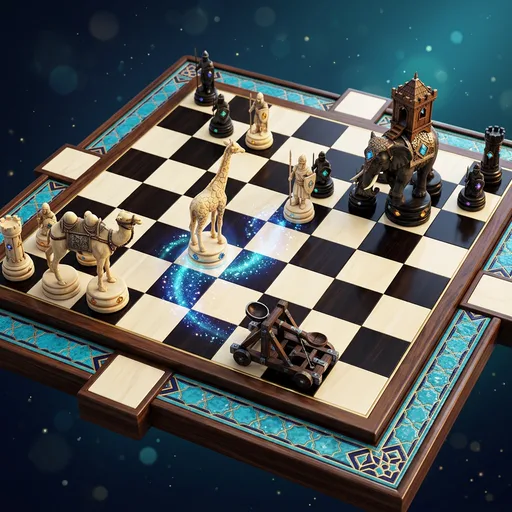
Play Tamerlane Chess Online
2 playersGiant chess from Samarkand! 12 kinds of pieces on an 11×10 board, such as the giraffe, the camel and the war engine; every pawn promotes to its own piece. Tap a piece to see how it moves. (2 players: bot, same device, online · beta, unranked)
▶ Play Tamerlane Chess — freeFree to play. Sign in with Google in seconds so your points, ranking and match history are saved. The app opens in English outside Turkey.
How to play Tamerlane Chess — the rules
- The board has 11 files × 10 ranks. Each player has 28 pieces: 6 leaping pieces on the back rank (Elephant, Camel, War engine), 11 pieces in front of them and 11 pawns at the front. White moves first.
- The King moves 1 square in any direction. The Ferz moves 1 square diagonally, the Wazir 1 square straight. The Rook and the Knight move as in modern chess.
- The Giraffe moves 1 square diagonally, then slides at least 3 squares straight on in the same general direction; the squares on its path must be empty. The Scout slides diagonally but must move at least 2 squares.
- The Elephant jumps exactly 2 squares diagonally, the War engine exactly 2 squares straight, and the Camel 3 straight + 1 sideways; all three jump over pieces in between.
- A pawn moves 1 square forward and captures diagonally forward; there is no 2-square first move and no en passant. Each pawn belongs to a piece (the letter in its corner): on the last rank it becomes that piece. The King's pawn and the Pawn of pawns become a Prince.
- The Prince moves like a king, 1 square in any direction, but it is not a king: it can be captured and is never in check.
- A player whose king is attacked (check!) must save it at once; you may not make a move that leaves your own king attacked. Whoever leaves the opponent's king with no escape (checkmate) wins.
- Stalemate wins too: if your opponent has no move left, even when their king is not attacked, you win (as in old chess).
- If your opponent has nothing left but the king (bare king), you win. If both sides have only their king, it is a draw.
- So that the game cannot go on forever, each player has 100 moves. If they run out, the higher piece-point total wins (Pawn 1; Ferz, Wazir, Elephant, War engine 2; Knight, Camel, Prince 3; Scout, Giraffe 4; Rook 5); if equal, it is a draw.
- Not all of the old rules are known; this game follows historian H. J. R. Murray's reconstruction, simplified for children: there are no "citadel" squares beside the board, no one-time swap of the king with another piece, and no three-step promotion of the Pawn of pawns.
- New (beta) game: no ranking points.
📜 Tamerlane Chess: the story of the game
Tamerlane chess developed in Central Asia in the late 14th century, under Timur (Tamerlane), who made Samarkand his capital; its invention is attributed to Timur himself. Timur is said to have preferred large-board chess to the 8×8 game and to have invited the best players of his time to his court, such as Ali ash-Shatranji of Tabriz. The board had pieces that modern chess does not, such as the giraffe, the camel and the war engine (dabbaba); every pawn belonged to a piece and became that piece on the last rank.
Did you know? Old Persian manuscripts describing the game have survived, but not every detail is clear. The rules played today largely follow the reconstruction by the British historian H. J. R. Murray in “A History of Chess”, published in 1913. The original board also had a “citadel” square on each side.
Where can I play?
Tamerlane Chess is free in Zeka Ustası ("Mind Master"). Play right in your browser on a computer, tablet or phone, or get the Android app. Practise against bots at many difficulty levels, or play real opponents from around the world in the online lobby.